

Chances are, you’ve seen productivity gurus whip out their laptops and fire up checklists to prepare for a new week.
It is the trick to a productive life, they promise.
To be fair, it works for them.
For example, Tiago Forte from Forte Labs calls the practice a life hack:
And you like the idea.
You like being super-duper organised, with a squeaky-clean week planned out.
But you’re thinking, nah, not for me.
Not because you love chaos, but because a weekly review feels rigid, overwhelming, and fussy.
That’s just not your style.
You’re not wired for rigid routines.
I’ve been in those shoes. I’d search for productivity hacks, and when Ali Abdaal recommends a weekly review, I wondered when I’d pull one off.
The idea seems great in principle.
But in practice? Not realistic.
I was either too busy or just didn’t see the point.
What is a weekly review?
A weekly review is a two-in-one activity:
- a reflection of the past week
- and a plan for the new one
You evaluate the prior week, check growth and progress, identify mistakes and lessons, and then strategize for the upcoming week.
In short, you map out the next seven days before it even starts.
Why you think you don’t need a review
Honestly, you probably know what a weekly review means.
The real question is what stops you from doing one?
There are four major reasons:
- A review feels unnecessary
You prefer spontaneity, the thrill of seeing what new moments bring.
No need to check the past or plan.
Not like you have anything to plan anyway.
2. You’d love to, but don’t have time
Pulling your life together each week sounds awesome. But you’re busy. A check-in demands an orderliness you just don’t have
3. You have the time, but don’t know how
You’ve tried templates, tools, and tricks.
But by Tuesday, the whole plan is ruined because of an unexpected trip to your hometown.
4. You’ve planned, but it’s not working
Perhaps you’ve tried weekly check-ins, but they haven’t improved your week or helped you follow through on your goals.
Instead, they add pressure and leave you feeling unproductive.
You don’t need a review to be successful
Most of reasons 1-4 above stem from a misconception about a weekly review.
Let’s start from the top.
A weekly review is not for methodical people.
You can be the most disorganized human and still apply one.
A weekly review is not stressful. You don’t need a checklist or an extra hour devoted to looking back on your week.
It doesn’t have to happen on a weekend or involve motivational slogans or charts. It doesn’t require much energy or time.
Weekly check-ins are not a requirement for success.
I doubt Albert Einstein spent Saturday mornings reviewing “what worked last week.” Yet he developed the theory of relativity and won the 1921 Nobel Prize in Physics.
You don’t need a review to be successful.
What you need, however, is structure and organization.
The Case for Structure: Why you need a weekly review
If you have responsibilities or any semblance of a “dream life”, then you need to pay attention to how you spend time.
You can’t escape it.
You can’t wing things and expect them to work out.
At best, you stumble into rare luck. At worst, you wake up at fifty and realize you’re far from the life you wanted.
A weekly review adds structure and order to how you live.
If you’re exceptionally disciplined, feel free to skip.
My guess is you’re not. Discipline rests on some kind of structure or system.
For many people, a weekly review is one of the simplest ways to create that.
How to Conduct a Successful Weekly Review
A successful weekly review is one that works for you, suits your schedule, personality, and preferences, and makes a difference in your workflow.
The key phrase is make a difference.
The last thing you need is a productivity hack that checks off the “I-am-productive” box but has no real impact on your work.
If a weekly review isn’t helping, you’re better off skipping it.
There are different ways to conduct a review.
Here are the general steps with tips to personalize the process:
Pick a day
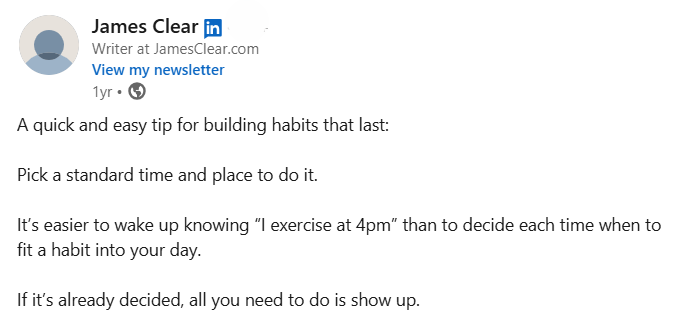
In author James Clear’s words,
“It’s easier to wake up knowing ‘I exercise at 4 pm’ than to decide each time when to fit a habit into your day.”
Because a weekly check-in should happen every seven days, many people choose a Saturday or Sunday.
I do mine on Sunday evenings or Monday mornings, depending on my mood.
You can decide on a weekday instead. It’s up to you.
Tip: Pick the day that feels easiest and most natural.
It could be Friday before work or Wednesday after dinner. If the idea of committing to a specific day scares you, start with options, e.g., Tuesday or Friday.
Then gradually settle for the day that works best.
Consider the medium of review
Do you prefer a random notes app or a structured Notion database?
Are you going to make mental notes (not advisable) or write them down?
Tip: Use the medium with the least friction.
Why settle for a 2-page template when three questions in a notes app work just as well?
Decide what to track.
What do you want to measure when you review a week? Goals, habits, routines?
For example, Sahil Bloom tracks four key areas:
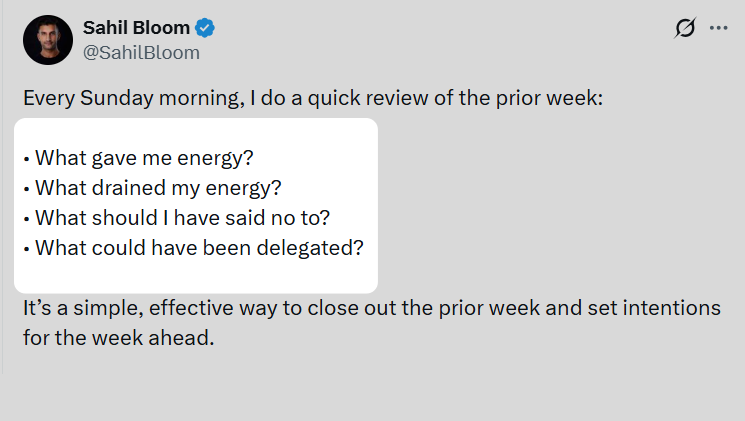
You could track sleep, progress, spending, and people you connected with.
It comes down to what matters most to you.
Here are a few more examples:
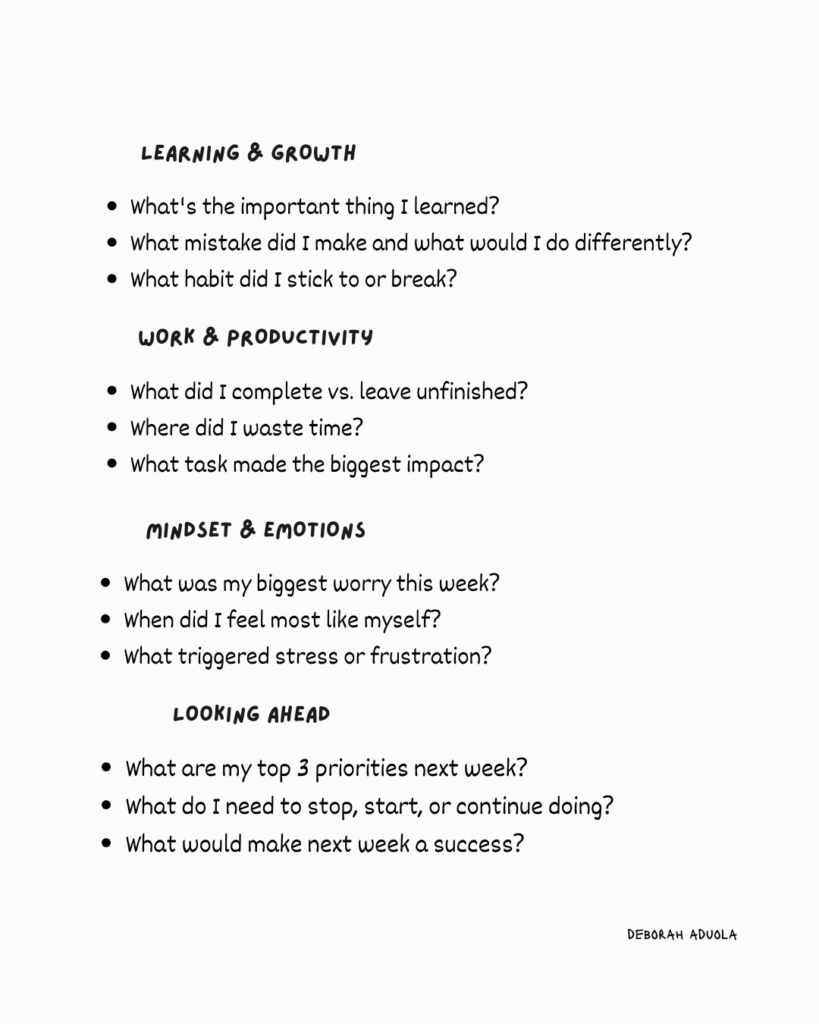
Tip: Start by asking which part of your week needs the most attention.
Time management? Goal setting?
Don’t track everything at once. Pick one to three measures, and add more as reviewing your week becomes a habit.
Start small
You’re excited to get a bit more organized, but don’t get ahead of yourself.
Start small. Pick a simple weekly routine you can actually maintain.
The steps above outline what makes a simple week review routine: the day, the medium, and the measures.
Define those, and set a rhythm that lets you show up even on your worst day.
Weekly Review Templates and Resources
We’ve covered the basics, but you might want to take it a step further and grab a ready-to-use template.
If that’s you, here are some suggestions.
Feel free to mix and match to find a style that fits you best.
1. Weekly Review Template from NotepadOne
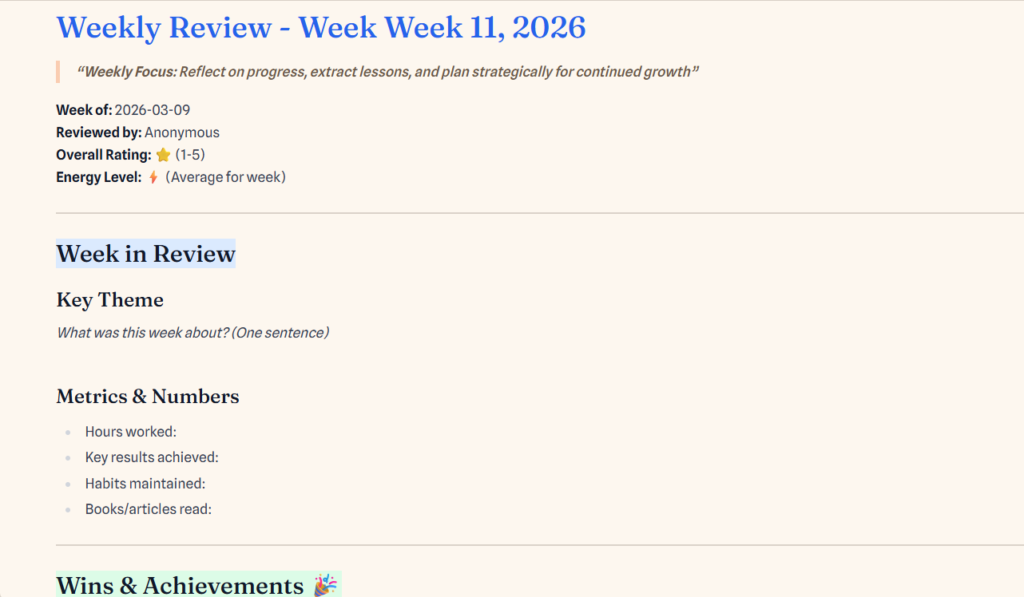
This template uses a journaling format that lets you reflect on achievements, challenges, and plans in one place.
It’s flexible, easy to customize, and works offline.
2. Weekly Reflection & Reset Template by Miroverse
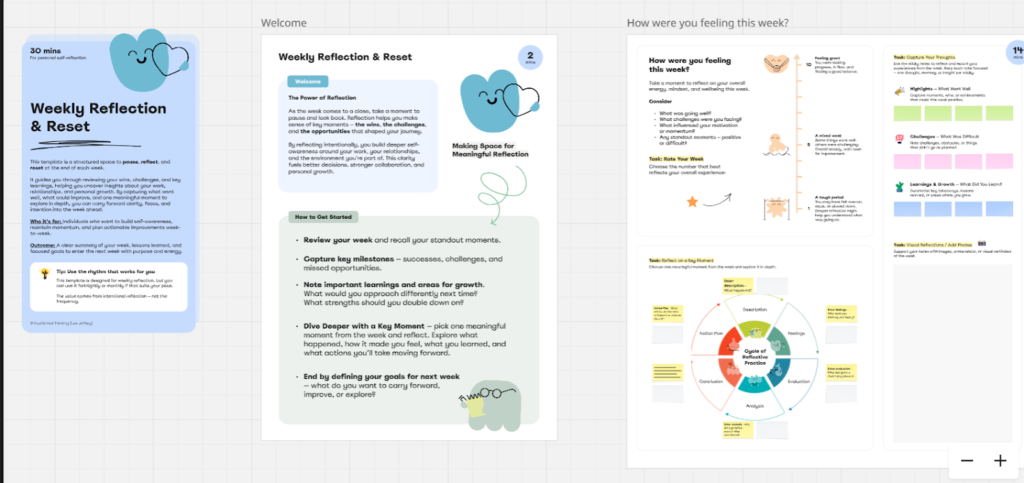
Miroverse uses a visual board-style template that guides you in planning for the week ahead.
You can use the template in the Miroverse app or print it.
3. Weekly Reflection Survey Form by Jotform
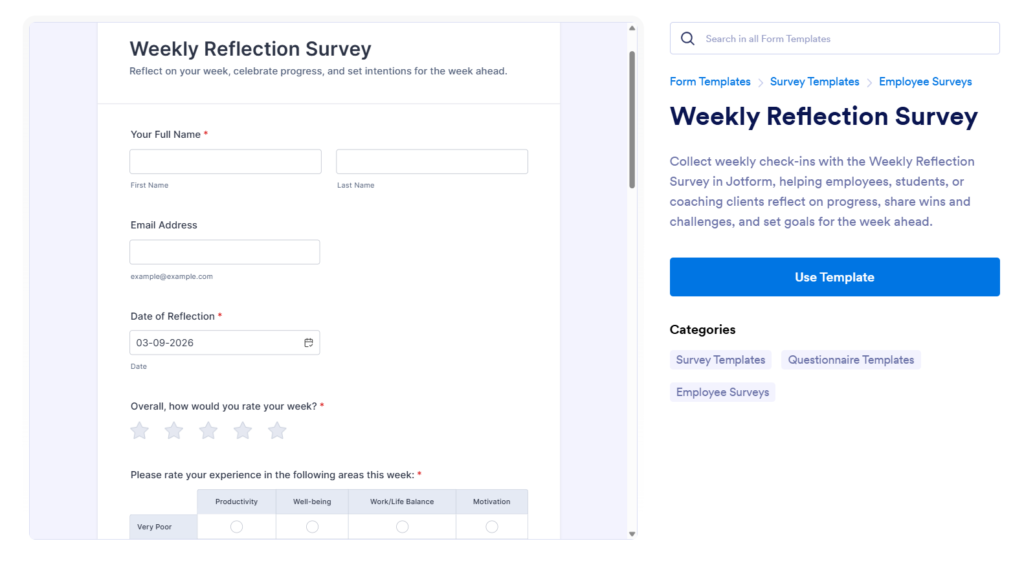
This template is a fillable survey-style form.
Great if you want consistent weekly data to spot trends over time.
4. Notion GTD Weekly Review Template
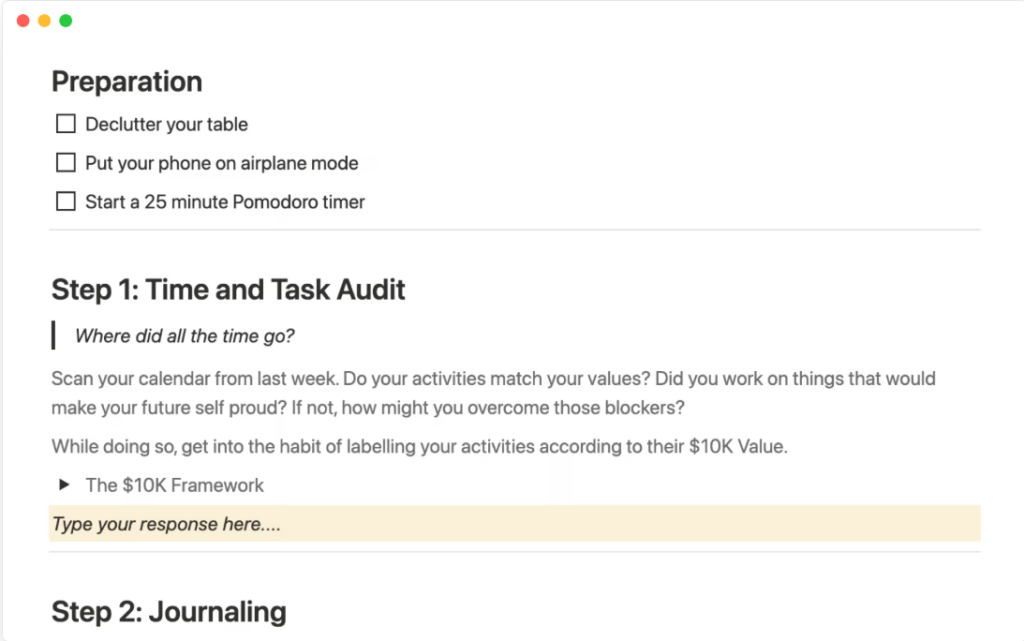
If you’re into Notion, this template is for you.
The process is inspired by David Allen’s Getting Things Done concept, to help you reflect and plan.
5. Free Printable Weekly Review Template
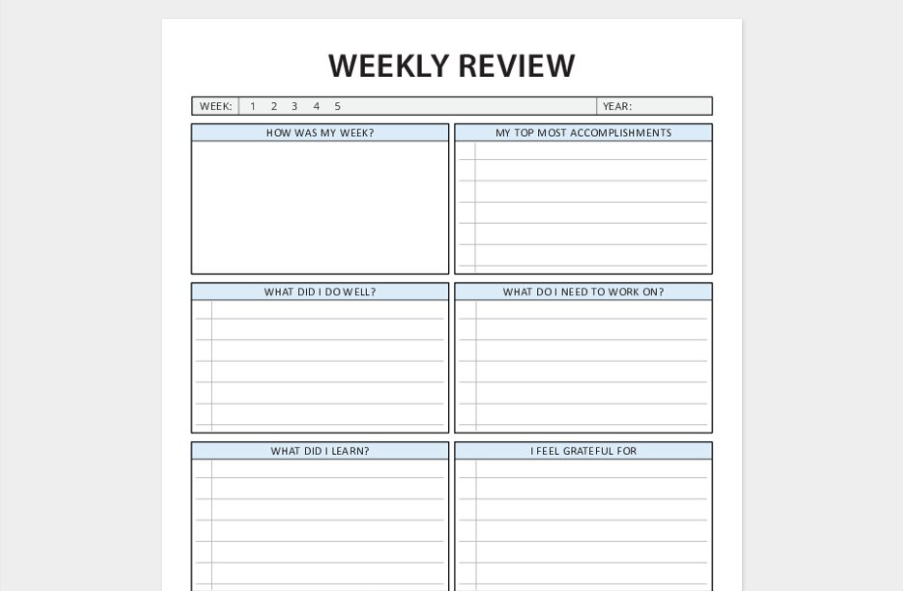
Finally, a printable PDF you can fill out by hand, with sections for accomplishments, learning points, emotions, and next‑week planning.
Performing a weekly review doesn’t have to be difficult.
It’s a simple rhythm that makes an end-of-the-year reflection easier, because you have a log of what 52 weeks looked like.
You don’t need to wait until December to course-correct.
Find a weekly check-in system that sticks, and use it to track your focus and efforts.