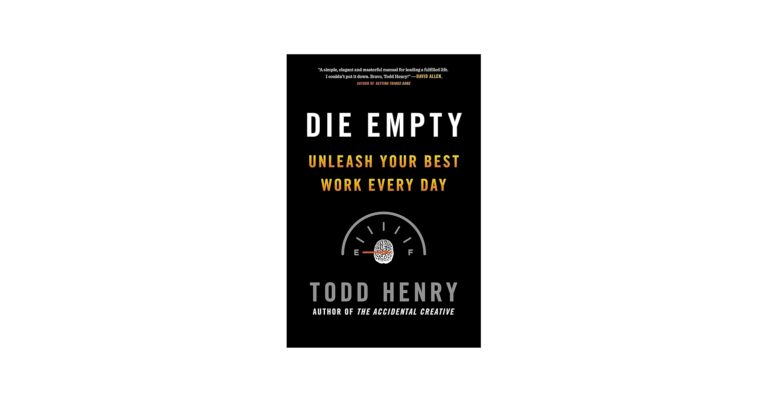
Die Empty was one of the first life-changing books I read.
When I say life-changing, I mean a book that forces you to roll on the bed, sigh, slump, and finally make some drastic decisions about how you live.
Die Empty was that book.
A friend recommended the book to me, and I have since recommended it to others. The notes and lessons I gleaned from Die Empty have stayed with me for the past four years. I have revisited them, made tweaks, and read them again.
It’s that good.
What makes it stand out so much?
The redefinition of work
The author spent the first part of the book re-defining what work means. In his words,
“Your body of work comprises the sum total of where you choose to place your limited focus, assets, time, and energy. I will define work as any instance where you make an effort to create value where it didn’t previously exist.“
Before reading this bit, I thought work meant work: Go to the office, get a job, be self-employed, anything that fetches a source of livelihood. But his perspective on work shattered that illusion.
Work, instead, is “any value you create that requires you to spend your time, focus, and energy—whether in the context of occupation, relationships, or parenting.”
Work is not only what benefits you. It is what you give to the world.
Here are some notes from that point:
You possess a one-of-a-kind combination of passions, skills, and experiences; there is something you bring to your work that no one else could.
Your worth as a person transcends the value you create, but your work is the most visible expression of your priorities. As you consider your current body of work and the sum of the value you’ve created, is it reflective of what you truly care about?
The irony of uniqueness
Todd Henry goes on to explain why we need to empty ourselves.
His philosophy throughout the book was this: You have unique qualities that need to be expressed.
You have a purpose; a combination of traits, skills, and talents you alone can bring to the table. But people are caught in the loop of making ends meet and doing work they don’t care about, and neglect the unique gifts they possess.
The great problems we see in the world today will not be solved by people functioning at half capacity, cranking out work they don’t care about in order to buy more things that will eventually rust or rot.
These problems will be solved by people who have tapped into their deeper aptitudes and who are pouring themselves fully into work that’s meaningful to them and valuable to others.
Many people realize this truth early. They know life is more than slaving away at half-hearted interests. But when you are thrown into the busyness of day-to-day activities, that desire takes the back burner.
The marketplace is filled with (often simplistic and unhelpful) platitudes about living a life of fulfillment, landing your dream job, and discovering your purpose, but when you are in the midst of the fray it can feel futile to think about anything other than hitting your deadlines and chasing the next promotion.
Challenging the obvious traps
He describes what stops us from doing great work (the ABCs of mediocrity) and suggests ways to challenge those constructs.
Brilliant work is forged by those who consistently approach their days with urgency and diligence. Urgency means leveraging your finite resources (focus, assets, time, energy) in a meaningful and productive way. Diligence means sharpening your skills and conducting your work in a manner that you won’t regret later.
Too many people want to come out of the gate with a clear understanding of their life’s mission. There is no one thing that you are wired to do, and there are many ways you can add value to the world, while operating in your sweet spot. However, these opportunities will only become clear over time as you act.
Active or Passive?
Eventually, we choose how we live.
We can grapple with an internal struggle that regrets choices we’ve made or not made. Or we can confront the odds, produce pieces that give value to the world, and bring unique perspectives that make society a better place.
Here are some more quotes I loved:
- Greatness emerges when you consistently choose to do what’s right, even when it’s uncomfortable.
- If making a significant impact was easy, it would be commonplace. It’s not common because there are many forces that lead to stagnancy and mediocrity.
- When we have to choose between doing work we’re proud of and just getting the job done, many of us feel compelled to do the latter.
- The only way to effectively gauge my work is to answer the question “Can I lay my head down tonight satisfied with the work I did today?”
- We live with the stubborn illusion that we will always have tomorrow to do today’s work. It’s a lie. We need to live with a sense of urgency about the work we do today.
- Emptying yourself of your best work isn’t just about checking off tasks on your to-do list; it’s about making steady, critical progress each day on the projects that matter, in all areas of life.
Love the book? Grab a copy on Amazon or at bookstores near you.
psstt: Feel free to share your thoughts on the idea of ‘dying’ empty 🙂